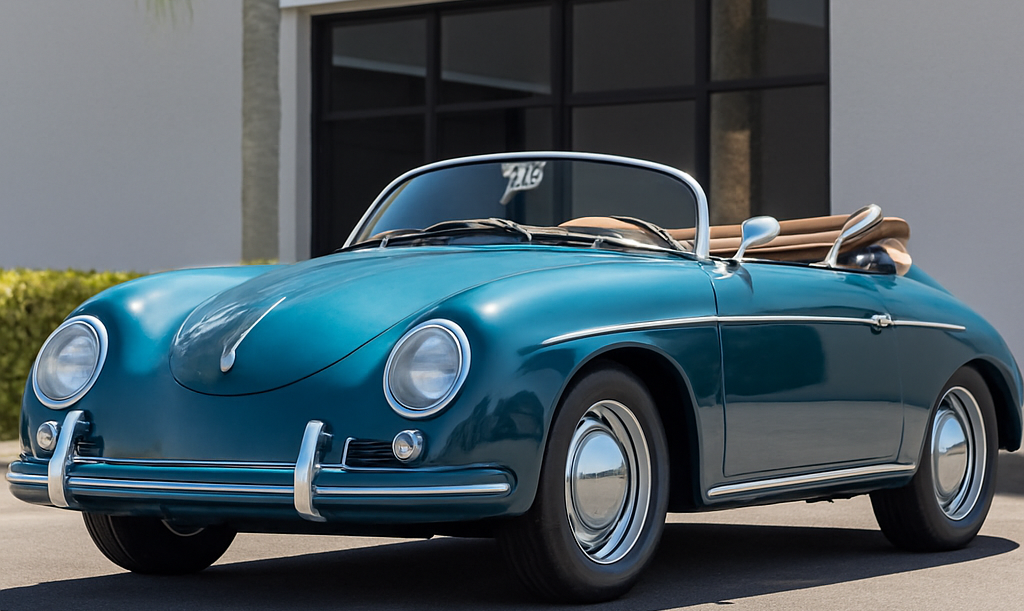
Most Porsche 356 replicas, Speedster kits included, are built around a Volkswagen Type 1 flat-four. The engine is cheap, simple and supported by a huge parts industry. It is also an air-cooled, pushrod, flat-tappet design that uses its oil as a coolant, which makes the choice of oil and the way you look after it more consequential than on almost any other classic.
This guide covers what the engine needs, which oils to buy, and the maintenance an owner can do with ordinary hand tools. It assumes a Type 1 based engine; if your replica carries a Subaru, jump to our Subaru-powered 356 replica oil guide, where the rules are quite different. Builds vary, so where your engine builder gives a specification, follow it over anything printed here.
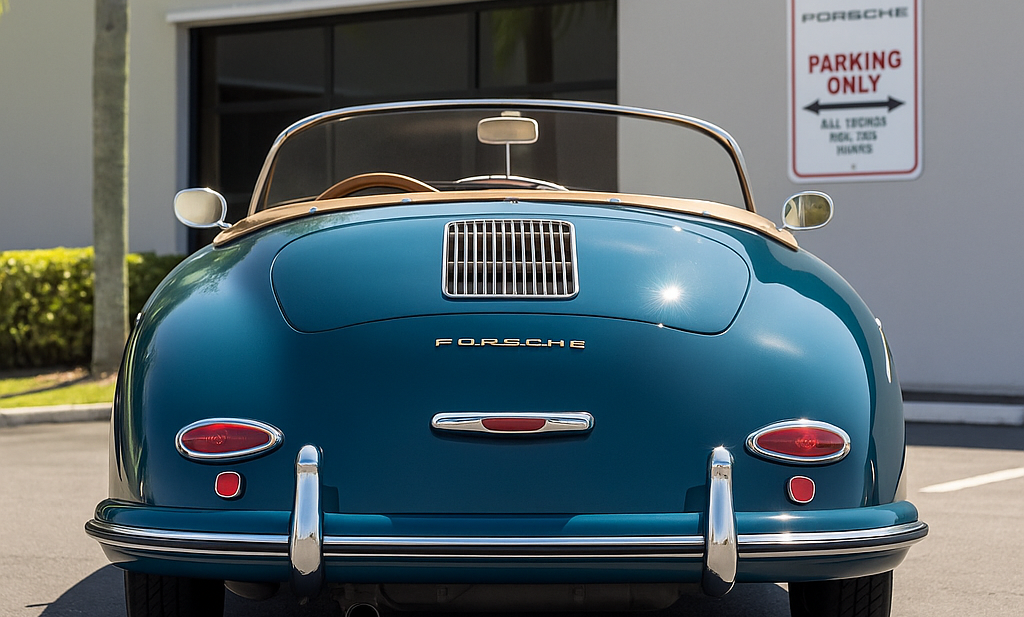
The Rear Engine Bay of a 356 Replica Is Small, Hot and Short of Airflow. The Oil Does Far More Than Lubricate.
The Key Numbers at a Glance
| Item | Guidance | Notes |
|---|---|---|
| Viscosity (warm climate) | 20W-50 | Standard for a healthy engine in warm weather. |
| Viscosity (cold climate) | 10W-30 to 10W-40 | Easier cold starts, with the same anti-wear package. |
| Zinc (ZDDP) | High, flat-tappet grade | Valvoline VR1 20W-50 lists 1,400 ppm zinc, 1,300 ppm phosphorus. |
| Oil temperature | 180-215 °F ideal | About 220 °F is the sustained ceiling, brief peaks to 230-240 °F. |
| Hot oil pressure | ~10 psi per 1,000 rpm, minimum | A widely used rule of thumb: about 30 psi hot at 3,000 rpm. |
| Stock case capacity | ~2.5 litres | Deep sumps and coolers hold more. Fill to the dipstick, not the number. |
| Oil and strainer service | 3,000 mi or yearly | First change after a few hundred miles on a new engine. |
Why an Air-Cooled Engine Is Hard on Oil
A water-cooled engine sheds most of its heat through the radiator. An air-cooled VW sheds a large share of it through the oil, which carries heat away from the heads and bearings to the sump and cooler. The same oil is therefore lubricating, cooling and cleaning at the same time, at temperatures a modern car engine never sees.
The valve train adds a second demand. A flat-tappet camshaft slides against its lifters under heavy spring load, the very design our engine oil types guide warns about, and it depends on zinc to survive.
Zinc (ZDDP): The Specification That Matters Most
Zinc and phosphorus (ZDDP) form a sacrificial anti-wear film on the cam lobes and lifter faces. Modern passenger-car oils have had these additives cut to protect catalytic converters, so an everyday 5W-30 does not protect a flat-tappet cam the way an older oil did. Our guide to mineral vs synthetic oil for classic cars explains the history in full.
How to choose, in order of reliability:
- Read the data sheet, not the label. If the manufacturer publishes zinc and phosphorus figures, use them. Valvoline’s VR1 Racing 20W-50 sheet lists 1,400 ppm zinc and 1,300 ppm phosphorus and states it is not recommended for vehicles with catalytic converters. A replica with no catalytic converter is a good fit.
- Be wary of anything that gives no figure. If the sheet is silent on zinc, you do not know what you are buying.
- Diesel oils such as Shell Rotella are widely used in air-cooled engines because heavy-duty diesel specifications keep more anti-wear chemistry than passenger-car oils. The Rotella T5 15W-40 data sheet lists API CK-4 and CJ-4 and does not publish a zinc figure, so confirm with your builder before relying on it.
- Motorcycle oils vary widely and are usually written around wet clutches rather than camshafts, so judge each one by its published numbers.
Which Viscosity?
VW’s own test specification at oil temperature called for SAE 30, and the old owner’s manual charts date from the 1970s. Today most air-cooled specialists work from the climate and the oil temperature you really see:
| Conditions | Viscosity | Notes |
|---|---|---|
| Warm to hot climate, spirited driving | 20W-50 | The default for most healthy replica builds. |
| Mixed climate, daily use | 15W-40 or 20W-50 | Both are common. |
| Cold winters, short trips | 10W-30 or 10W-40 | Most wear happens at start-up, so cold flow matters. |
| Frequent starts below freezing | 5W-40 or 15W-50 | Some builders step to these multigrades. |
| New or rebuilt engine | Your builder’s break-in oil | For the first few hundred miles. |
Synthetic or Mineral?
This is the most argued-over question in the air-cooled world, and the honest answer is that it is not settled. Some parts houses advise mineral oil in a standard engine, and some builders run synthetic happily. Synthetics resist heat breakdown and flow better when cold; mineral oils are what the engine was designed around. What is not in dispute is the order of priorities: a correct anti-wear package matters more than the base oil, and a fresh engine should be run in on whatever your builder specifies.
Break-In Oil for a Fresh Engine
A new or rebuilt engine needs its rings, bearings and cam to seat. Most builders specify a dedicated break-in oil, or a conventional straight or 20W-50 oil, for the first few hundred miles, followed by an early oil change and strainer clean to remove the wear-in material. Driven’s BR30 is a conventional 5W-30 sold as a break-in oil, described as engineered for ring sealing and needing no additives. Its data sheet does not list zinc, and it does not say whether it is for flat-tappet engines, so check with your builder before using it on a VW.
Our Top Oils for VW-Powered 356 Replicas
Prices change daily, so check the current price on Amazon. Always confirm the grade against your builder’s recommendation.
1. Valvoline VR1 Racing 20W-50
The benchmark for a high-zinc 20W-50. The manufacturer’s data sheet publishes 1,400 ppm zinc and 1,300 ppm phosphorus, and the oil is aimed at street and track use in gasoline engines without catalytic converters.
2. Valvoline VR1 Racing 10W-30
The same VR1 line in a thinner grade, for cooler climates or an owner who mostly makes short trips and wants quicker flow on a cold start. Check the current data sheet for this grade’s zinc figure.
3. Driven BR30 Conventional 5W-30 Break-In Oil
A break-in option for a fresh or rebuilt engine, to be followed by an early change into your long-term oil. Confirm suitability with your engine builder first.
Owner Maintenance Schedule
A VW Type 1 rewards an owner who looks at it. Almost everything below needs only hand tools.
| When | What to do |
|---|---|
| Every drive or fuel stop | Check the dipstick on level ground, and look underneath for fresh drips. Note oil temperature and pressure on the gauges. |
| First 300-500 miles on a new engine | Change the oil, clean the strainer, re-torque and recheck what your builder tells you to. |
| Every 3,000 miles or yearly | Change the oil and clean the strainer. Replace the sump and strainer gaskets each time. |
| Regularly, engine cold | Check valve clearances. Many owners do this at every second oil change. |
| Every service | Inspect the fan belt condition and tension, the cooling tinware, the thermostat flap and the oil cooler for leaks or blockage. |
| Every year | Look for oil weeping from the pushrod tubes, valve covers and sump, and trace any leak before it becomes a failure. |
How to Change the Oil and Clean the Strainer
- Warm the engine briefly, park on level ground, and support the car on jack stands, never on a jack alone.
- Drain the oil by removing the drain plug if your sump has one, or by removing the sump plate nuts on a stock engine. Have a large drain pan ready, because the oil is hot.
- Remove the strainer and wash it in solvent, then dry it with compressed air. Replace it if the mesh is damaged. Look for metal or sludge on it, which is the cheapest early warning your engine gives.
- Fit new gaskets to the strainer and the sump plate, lightly oiled, and new copper crush washers on the acorn nuts.
- Tighten evenly, working in a cross pattern. One engine builder’s reference gives about 5 lb-ft (about 7 N·m) for the sump cover acorn nuts with copper crush washers. Check the figure for your own sump, and do not overtighten.
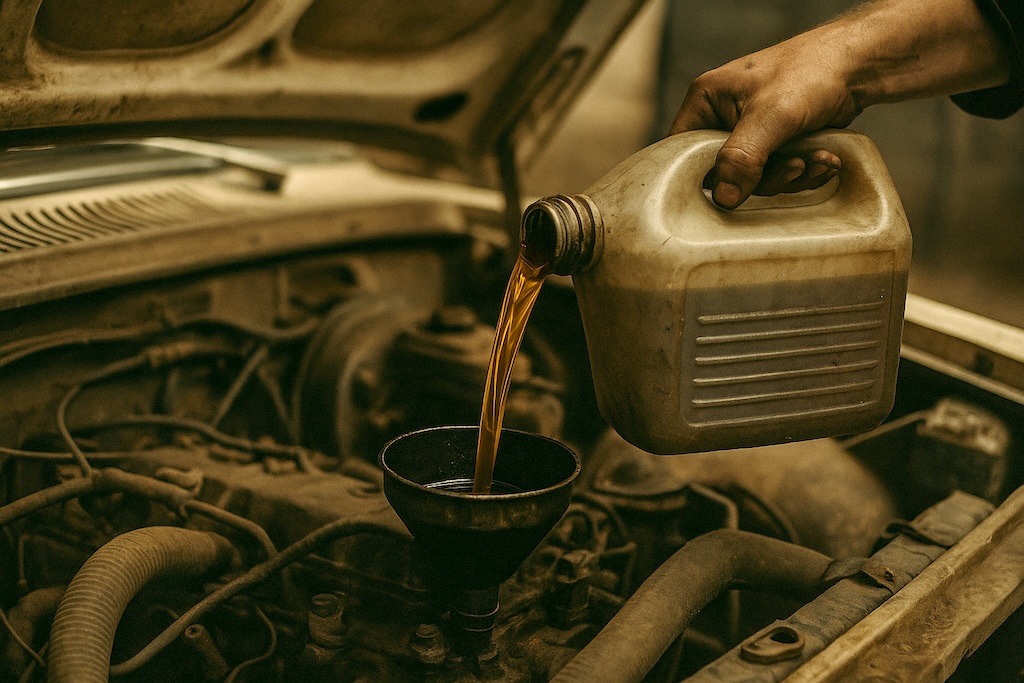
- Refill with the oil you have chosen, and check the dipstick. Capacity depends on the case and sump, so fill to the mark.
- Start the engine and confirm the oil pressure light goes out at once. Check for leaks, take a short drive, then recheck the level and look for drips.
Fitting an oil filter to a stock Type 1 is a different job, because the stock engine has a strainer and no filter. If you want one, discuss a remote filter kit with your builder rather than improvising, since poorly plumbed oil lines can starve the engine.
How to Check the Valve Clearances
Valve lash is one of the most useful owner jobs on an air-cooled VW. The figures below are for a stock Type 1 and should be confirmed against your own build sheet.
- Engine fully cold. Do not start the car before you adjust, and park it where it will stay cool overnight.
- Find top dead center on cylinder 1. Turn the engine by the crank pulley bolt until the distributor rotor points at the notch in the distributor rim and the pulley mark lines up with the case split.
- Remove the valve cover by unclipping the spring bale, with new gaskets ready.
- Set the clearance. A stock engine with aluminum pushrods uses 0.006 inch (0.15 mm) on both intake and exhaust, set with a feeler gauge between the adjuster and the valve stem. Chromoly pushrods are normally set to zero lash, so know what you have.
- Work in firing order, 1-4-3-2, turning the engine 180 degrees between cylinders.
- Close up with new gaskets and recheck for leaks on the first run.
Reading Oil Temperature and Pressure
Do not rely on the oil light. It warns you when the damage has already started. Fit a temperature sender, ideally in the sump, and a pressure gauge. Aim for 180 to 215 °F. If oil temperature is regularly above about 220 °F, look for causes before you blame the oil: missing or bent cooling tinware, a slack fan belt, a stuck thermostat flap, a blocked oil cooler, a lean mixture or retarded timing. For pressure, the working rule is at least 10 psi per 1,000 rpm when hot. Falling hot pressure is a sign of bearing wear or a failing pump, so act on it.
Tools and Supplies Worth Owning
- A feeler gauge set for valve clearances. Browse feeler gauge sets on Amazon.
- A small torque wrench for the sump nuts and engine fasteners. Browse torque wrenches on Amazon.
- An oil temperature gauge kit. Browse VW oil temperature gauges on Amazon.
- Gasket kits for the sump plate and strainer. Browse VW sump plate gasket kits on Amazon.
Conclusion
The right oil for a VW-powered 356 replica comes down to a few disciplines: a published zinc figure, a viscosity that suits your climate, a proper break-in, regular changes with a clean strainer, and gauges that tell you the truth about temperature and pressure. Do these and the engine will repay you. For the wider picture, see our best engine oils for classic cars, keep the gearbox healthy with our transmission fluid guide, and have a look at the Porsche 356 holiday garage and gift guide for garage kit.
Affiliate Disclosure: This post contains affiliate links. If you purchase through these links, we may earn a small commission at no additional cost to you. This helps us keep producing valuable content. Thank you for your support!
-
Best Oil for Subaru-Powered Porsche 356 Replicas (2026)
Building a 356 replica around a Subaru boxer? Here is the oil, viscosity and filter that keep it cool and reliable.
-
Understanding Engine Oil Types: Classic Cars Essential Guide (2026)
Discover the top engine oils for classic cars, with oil types, benefits and recommendations.
-
Mineral vs Synthetic Oil for Classic Cars Guide (2026)
ZDDP requirements, viscosity tips and recommendations for classic car engines.
-
Holiday Garage & Gift Guide for Porsche 356 Lovers (2026)
Own a Porsche 356 replica? Must-haves to keep your dream car gleaming.